

Home

New Paper in Sensors
Thursday, 12 November 2009
Curvature-Based Environment Description for Robot Navigation Using Laser Range Sensors
Sensors 2009, 9, 5894-5918; doi:10.3390/s90805894

Abstract
This work proposes a new feature detection and description approach for mobile robot navigation using 2D laser range sensors. The whole process consists of two main modules: a sensor data segmentation module and a feature detection and characterization module. The segmentation module is divided in two consecutive stages: First, the segmentation stage divides the laser scan into clusters of consecutive range readings using a distance-based criterion. Then, the second stage estimates the curvature function associated to each cluster and uses it to split it into a set of straight-line and curve segments. The curvature is calculated using a triangle-area representation where, contrary to previous approaches, the triangle side lengths at each range reading are adapted to the local variations of the laser scan, removing noise without missing relevant points. This representation remains unchanged in translation or rotation, and it is also robust against noise. Thus, it is able to provide the same segmentation results although the scene will be perceived from different viewpoints. Therefore, segmentation results are used to characterize the environment using line and curve segments, real and virtual corners and edges. Real scan data collected from different environments by using different platforms are used in the experiments in order to evaluate the proposed environment description algorithm.
 
New Paper in Robotica
Thursday, 12 November 2009
Fast laser scan matching approach based on adaptive curvature estimation for mobile robots
Volume 27, pp. 469–479. Cambridge University Press 2009

Abstract
This paper describes a complete laser-based approach for tracking the pose of a robot in a dynamic environment. The main novelty of this approach is that the matching between consecutively acquired scans is achieved using their associated curvature-based representations. The proposed scan matching algorithm consists of three stages. Firstly, the whole raw laser data is segmented into groups of consecutive range readings using a distance-based criterion and the curvature function for each group is computed. Then, this set of curvature functions is matched to the set of curvature functions associated to the previously acquired laser scan. Finally, characteristic points of pairwise curvature functions are matched and used to correctlyobtain the best local alignment between consecutive scans. A closed form solution is employed for computing the optimal transformation and minimizing the robot pose shift error without iterations. Thus, the system is outstanding in terms of accuracy and computation time. The implemented algorithm is evaluated and compared to three state of the art scan matching approaches.
 
2 New Papers in IROS09
Thursday, 12 November 2009
Combined Constraint Matching Algorithm for Stereo Visual Odometry based on Local Interest Points
P. Núñez, R. Vázquez-Martín, A. Bandera, and F. Sandoval,

Abstract
In this paper, we describe a new approach which uses scale-invariant image features to estimate the motion of a stereo head. These point features are matched between pairs of frames and linked into image trajectories at video rate, generating what it is called visual odometry, i.e. motion stimates from visual input alone. With respect to previously proposed approaches, the main novelty of our proposal is that the matching between sets of features associated to stereo pairs and between sets of image features associated to consecutive frames are conducted by means of a fast combined constraint matching algorithm. Besides, the efficiency of the approach is increased by using a closed-form solution to estimate the final robot displacement between consecutive acquired frames. We have tested the proposed approach for navigational purposes in a real environment. Experimental results demonstrate the performance of the proposal.

Novelty Detection and 3D Shape Retrieval based on Gaussian Mixture Models for Autonomous Surveillance Robotics
P. Núñez, P. Drews Jr, R. Rocha, M. Campos and J. Dias
 
Abstract
This paper describes an efficient method for retrieving the 3-dimensional shape associated to novelties in the environment of an autonomous robot, which is equipped with a laser range finder. First, changes are detected over the point
clouds using a combination of the Gaussian Mixture Model GMM) and the Earth Mover’s Distance (EMD) algorithms. Next, the shape retrieval is achieved using two different algorithms. First, new samplings are generated from each Gaussian function, followed by a Random Sampling Consensus (RANSAC) algorithm to retrieve geometric primitives. Furthermore, a new algorithm is developed to directly retrieve the shape according to the mathematical space of Gaussian mixture. In this paper, the set of geometric primitives has been limited to the set C  {sphere, cylinder, plane}. The two shape retrieval methods are compared in terms of computational cost and accuracy.
Experimental results in various real and simulated scenarios demonstrate the feasibility of the approach.
 
New Paper in ECMR 2009
Thursday, 12 November 2009
Data Fusion Calibration for a 3D Laser Range Finder and a Camera using Inertial Data
P. Núñez, P. Drews Jr, R. Rocha and J. Dias
 
Abstract
The use of 3D laser range nder (LRF) and cameras is increasingly common in the navigation application for mobile robots. This paper proposes a new method to erform the extrinsic calibration between a pinhole camera and a 3D-LRF with the aid of an Inertial Measurement Unit IMU). While state of the art calibration procedures require a large number of points for robust calibration, the proposed approach is innovate in terms of higher flexibility and widerrange of application. The proposed method is based on the resentation to the sensor platform of a stationary planar board containing a checkerboard pattern. The homography which defines the rotation matrix between the LRF and camera is achieved moving the robot and observing the resulting motion of the sensors. This step attempts to solve the well-known homogeneous transform equation of the form AX = BX. Next, translation is calculated using a commonly least-squaresestimation algorithm according to the corners of the pattern, previously detected by both, camera and LRF. The developed algorithm was tested on a mobile robot which is equipped with lensor platform composed of pinhole camera, LRF pan-tilt unit and a IMU, and proved to be very accurate. Furthermore, the applicability of the method is greatly expanded, requiring attachment of a simple inertial sensor to the sensor platform.
 
ACROSS Project
Thursday, 12 November 2009

Robolab and Quercus Software Engineering Group participate in the ACROSS consortium

The Across ( Auto-Configurable Robots for Social Service) project is co-funded by the Spanish ministry of Industry, Tourism and Commerce within Plan Avanza . It has a lifespan of 27 months (October-2009, December 2011) and a final budget of more than 6M€. There are 13 partners involved, 5 companies, 3 universities, 2 technological centers and 2 Hospitals. 

 
New MSc Thesis
Monday, 05 October 2009

Técnicas visuales de reconocimiento de objetos en robots
móviles.

Ramón CintasPeña

Robolab - Universidad de Extremadura - 2009

Abstract:

El empleo de la robótica en los entornos industriales es una práctica generalizada.

La industrialización y automatización de los almacenes es un recurso cada vez más utilizado. Para conseguir estos fines, se ha desarrollado un creciente apoyo tecnológico a las actividades de almacenaje a partir del empleo de equipos cada vez más sofisticados y automatizados.

Este proyecto intenta abordar la problemática del transporte de mercancías dentro de los almacenes desde un punto de vista más sencillo. En concreto, se pretende automatizar una carretilla elevadora de forma que pueda llevar a cabo la tarea de forma autónoma. Para ello se simulará el entorno mediante la plataforma robótica RobEx.

El desarrollo del proyecto se centra en el diseño de técnicas que permitan el reconocimiento visual de un palé, la generación de una trayectoria de aproximación que permita llegar hasta él con la orientación adecuada para, a continuación, llevarlo a una posición de destino.

La identificación se lleva a cabo utilizando la información extraída de los colores de la imagen así como de una serie de transformaciones geométricas que permiten estimar la posición de un objeto partiendo únicamente de esta información. Mientras que la trayectoria se aborda desde un punto de vista matemático.

La memoria del proyecto, indica los problemas encarados y cómo han sido resueltos, muestra los resultados de los experimentos, e introduce RobEx y RoboComp, las plataformas hardware y software usadas. El código del proyecto fin de carrera se ha incorporado a RoboComp (repositorio de componentes software para robótica).


New MSc Thesis
Wednesday, 09 September 2009

Localización Esterefónica en Robots Móviles.

LuisVicente Calderita Estévez

Robolab - Universidad de Extremadura - 2009

Abstract:

El Laboratorio de Robótica y visión artificial de la Universidad de Extremadura (Robolab) lleva varios años dedicado al estudio de la visión y ha realizado trabajos muy interesantes en estos campos. Junto con la movilidad del robot ha conseguido la navegación de manera autónoma esquivando objetos a su paso..., ha conseguido reconocer elementos de su entorno, enfocar, acercarse, seguir trayectorias, en definitiva, a ojos de un observador ajeno, la familia RobEx parece estar dotada de un sentido visual primigenio.

La cuestión de: ¿por qué no oye si ya ve?, invadió mi cabeza al poco tiempo de conocer las funcionalidades anteriores, la percepción del entorno de los humanos y su ubicación relativa en el espacio tiene un alto componente auditivo, si bien el ojo nos puede dar la impresión de ser un sentido dominante e incluso suficiente, el oído nos ayuda en esa localización.

El ideal era conseguir, a largo plazo, una capacidad de atención por parte del robot, conseguir que al llamarlo, por ejemplo, nos mirara. Por supuesto el listón estaba muy alto y no sería alcanzable para un proyecto final de carrera, pero sí se podrían sentar las bases de ese futuro: empezar a oír y empezar a orientarse.


WAF 2009
Saturday, 05 September 2009

This year Robolab organized WAF 2009 

September 10th and 11th, 2009

Escuela Politécnica - Universidad de Extremadura

Cáceres - Spain

 
New MSc Thesis
Wednesday, 05 August 2009

Navegación Visual en Robots Móviles

Luis J. Manso

Robolab - Universidad de Extremadura - 2009

Abstract:

La navegación autónoma es la habilidad que diferencia a los robots móviles del resto. Uno de los requisitos más esenciales para desplazarse es la detección de obstáculos. El proyecto tiene como objetivo desarrollar un sistema visual de detección de obstáculos alternativo a los existentes. A pesar de que ya existen enfoques basados en láser que dan buenos resultados para la navegación autónoma, sus precios son elevados y carecen de algunas características deseables. Debido a esto, resulta interesante disponer de una alternativa de bajo coste que siga manteniendo los requisitos de eficacia y eficiencia.
La solución a la que se llega es a un sistema de detección de obstáculos basado en la fusión de múltiples clasificaciones, una que se basa en información geométrica y otra basada en información cromática.
La memoria del proyecto, además de detallar la solución desarrollada, la compara con otras opciones previas, indica los problemas encarados y cómo han sido resueltos, muestra los resultados de los experimentos, e introduce RobEx y RoboComp, las plataformas hardware y software usadas. Finalmente, se describe la puesta en marcha del sistema en un robot RobEx.
Además, para demostrar la bondad del sistema desarrollado, el capítulo 5 se dedica a la descripción de los múltiples experimentos realizados y los resultados y conclusiones que se han extraido de la ejecución de los mismos.
El código del proyecto de fin de carrera se ha incorporado a RoboComp (repositorio de componentes software para robótica). Además, también se puede encontrar en el disco que acompaña a la memoria del proyecto, junto con videos y fotografías tomadas durante la fase de experimentación.

Videos:

Videos of the the robot detecting obstacles and navigating: youtube(1) , youtube(2)


VELETA ROCK GLACIER
Wednesday, 01 April 2009
Abstract— Rock glacier is a rare case of study for 3D modelling.
This type of models has particular properties which make it a
special application for multi-view stereo reconstruction
algorithms. In this work we analize different types of methods for
dense reconstruction from wide base-line views. Besides that we
select a method which was adapted and implemented for the
specific case of rock glacier modelling. Principally we add two
suitable innovations: implement a pyramidal image structure for
get more efficient computation and use a feature-based method to
obtain a initial terrain surface and improve the depth estimation.
The proposed method has been tested in a real rock glacier
example (Veleta in Sierra Nevada, Spain) with good results.
Read more...
 
Robolab on Canal Extremadura Tv
Sunday, 30 November 2008
The Robolab team has been interviewed for Conecta-T , a program of Canal Extremadura TV . You can download the video here .
 
New paper published as a book chapter
Friday, 28 November 2008
Attentional Selection for Action in Mobile Robots
Authors: Pilar Bachiller, Pablo Bustos and Luis J. Manso
Source: Advances in Robotics, Automation and Control, ISBN 978-953-7619-16-9


RobEx brain keeps growing...
Thursday, 30 October 2008
Robex new brain
 
New MSc Thesis
Thursday, 09 October 2008

Visual Categorization in RobEx 

Laura Rubio Castro

Robolab - Universidad de Extremadura - 2008

Abstract:

Videos:

 Videos of the the robot detecting and recognizing objects while moving video1 (6.6MB) video2 (12.6MB)


New PhD. Thesis
Thursday, 09 October 2008

Pilar Bachiller Burgos

Robolab- Universidad de Extremadura - 2008

 
Abstract:
During the last few years, attention has become an important issue in machine vision. Studies of attentional
mechanisms in biological vision have inspired many computational models. Most of them follow
the assumption of limited capacity associated to the role of attention from psychological proposals. These
theories hypothesize that the visual system has limited capacity of processing and that attention acts as
a filter that selects the information that should be processed at each time. This assumption has been
criticized by many authors who afirm that processing capacity of human perceptual systems is enormous.
From this view, there is no need for an stage of selection of the information to be processed. Instead, they
claim the role of attention from the perspective of selection for action. According to this new conception,
the function of attention is to avoid a behavioral disorganization by selecting the appropriate information
to drive task execution. Such a notion of attention is very interesting in robotics where the aim is to
build autonomous robots that interact with complex environments, keeping multiple behavioral objectives.
Attentional selection for action can guide robot behaviors by focusing on relevant visual targets while
avoiding distracters. Moreover, it can be conceived as a coordination mechanism, since it allows serializing
the actions of, potentially, multiple active behaviors. To exploit these ideas, we propose a visual attention
system based on the selection for action theory. It has been design and tested on a mobile robot endowed
with a stereo vision head.
The proposed system has been modeled as a collection of components collaborating to select, fix and
track visual targets according to different task requirements. The low level components are related to image
acquisition, motor control, as well as computation and maintenance of regions of interest (ROI). Components
of intermediate level are in charge of extracting sets of ROI features related to what (appearance
information) and how (spatial information) matters. These features are used by high level components,
called target selectors (TS), to drive attention according to certain top-down behavioral specifications.
Attention control is not centralized, but distributed among several target selectors. Each of them drives
attention from different top-down specifications to focus on different types of visual targets. At a given
time, overt attention is driven by one TS, while the rest attends covertly to their corresponding targets.
The frequency of overt control of attention of each TS is modulated by high level behavioral units according
to their information requirements. The fixation of a selected target is accomplished by two independent
camera movements: a saccadic and tracking movement in one of the cameras and a vergence movement
in the other. This allows controlling attention from monocular information while keeping stable binocular
fixation. Once this perceptual-motor process is completed, the foveated target is sent to the behavioral
units. Only actions compatible with the focus of attention are then executed, solving the behavior coordination
problem. The whole system works as a control architecture that is attracted towards different visual
targets to keep several behavioral goals. The specific interleaving between actions is given by an implicit
time relation that links internal parameters and external world features.
Videos:  (use this codec if in Windows)
You can find some experimental results of this thesis here: naveg1.avi   naveg2.avi   naveg3.avi   naveg4.avi
 
Paper accepted in WAF 2008
Saturday, 02 August 2008
The paper Manteniendo el foco: control de seguimiento y vergencia en un sistema de atención visual has been accepted for the WAF2008 conference. We describe in it the internal functioning of TrackerComp and VergenceComp components showing several real examples in hard situations. For example, the images below show a difficult vergence setup in which there is not initial texture in the center of the images (left image). Left is dominant, right slave. By going up through the images pyramid (scale-space) the algorithm gathers more context until it finds texture enough to gaze the slave camera (right image). 


Moved to sourceforge.net
Saturday, 02 August 2008

Since 01-August-2008 our software repository is hosted in http://robocomp.wiki.sourceforge.net/ We are writing there new documentation and instalation instructions.


Robex meets the undergraduates
Friday, 08 February 2008
 View of the classrom with the robots used in the courseWe just finished our second undergraduate Robotics course using two Robex units. 
Several groups have succesfully completed a visual localization task 
using particle filters. Not bad for an introductory 4-months course!! Shortly we will upload the videos delivered by the groups.
 
And let the robot eat...
Friday, 08 February 2008


  We have built a charger for the robex robots.This mechanical design lets the robot make contact with two small sliding rods placed underneath the lower floor. The device can recgarge both the laptop and the lipo battery that energizes the motors. 


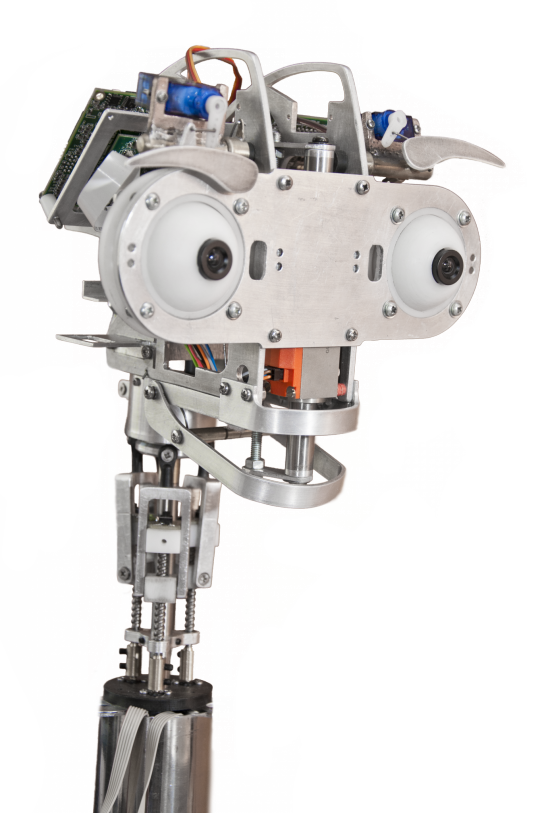
New robotic head for the Robex series
Friday, 08 February 2008
  Two robots have been endowed with a new stereo head made of aluminium and powered by two three servomotors from Robotis.
This servos are driven by an internal microcontroller that can communicate with the on board computer at 1Mb/s rate through a RS485 semiduplex bus. The internal program measures position, velocity and current. These variables and several others related to internal configuration can be easily accessed and modified.
Angular resolution is 1024 ppr and& maximun rotation speed is 1.5 rps